The data management community is increasingly interested in helping the larger scientific community organize, query, and process large data sets. I got to work on a really interesting bioinformatics problem this summer that involved a significant data processing and computational aspect. In the abstract, the problem is a learning task -- there are several items in a dataset, and each item has millions of features. Assume that each feature is categorical and can take one of three values. Each item is also associated with a set of "observations". Observations can be either categorical (eg. disease/no disease) or continuous. The objective is to predict the observations for unseen items.
This turns into a difficult model selection problem and various constraints are used from domain knowledge to reduce the space of possible models. For instance, consider the assumption that an observation can be explained using exactly one feature. Each of the features can be tested to see how well they can predict the observation using some learning technique (decision trees, regression, SVMs, etc.). If we find a good predictor, we also need to calculate a P-value. That is, the likelihood that such a good fit could have risen by chance. Furthermore, we may have to correct for the fact that we just evaluated millions of hypotheses (features). Multiple hypothesis testing in the statistical literature deals with assessing significance when many different statistical tests are performed. One of the techniques used ,when there's no easy closed-form technique for correcting for multiple hypotheses is to use permutations -- ie, the null hypothesis is that the observations have nothing to do with the actual features, so you hold the items in place, and randomly permute the observations. Any feature that is significant now is purely by chance. Repeating this computation a million times and finding only 1 good fit can be used to infer that the P-value is around 1 in a million, which is pretty significant.
The data sizes for this problem are small enough (in the tens or hundreds of gigabytes) that it can be solved on a single machine. But the processing demands are large enough that it makes sense to parallelize the solution. A traditional approach to solving this problem would have used an HPC-like setting. I worked with domain scientists to build a solution using several open source components including Hadoop, R, and RHIPE. In the coming weeks, I'll talk about what we learned from this approach -- what worked for the domain scientists, and what didn't. What parts helped increase the scientist's productivity and what hampered it.
Monday, December 5, 2011

Thursday, November 17, 2011
Analytic DBMS Landscape
Curt Monash has a great post describing eight kinds of analytic DBMSes. Here's a picture that presents a simplified view, but I highly recommend the original post. There are three major groups: the big enterprise data warehouses (EDWs), various kinds of data marts, and what he calls the "bit bucket" category -- which is where he places Hadoop. I've left out the "archival store" and the "operational analytic server" which was essentially a catch-all category.
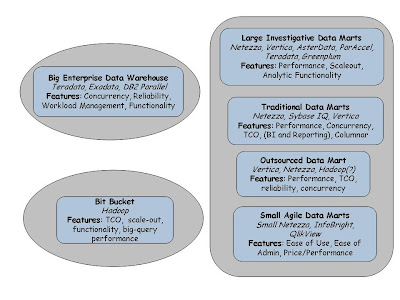
Let's look at Hadoop and related technologies -- Monash argues that this is the "big bit bucket" category. A place to gather large amounts of data cheaply and do some analytics .This is the kind of data that you'd normally consider too low-value to justify putting it inside your gold-plated EDW. As Hadoop gets better at TCO, performance, and adds better support for reporting, high-level analytics, and workload management -- how is it going to affect the other spaces? I've argued before that Hadoop is not going to be the next platform for EDWs for a long time to come.
One way to look at an improved Hadoop is as a bigger, more reliable, lower cost player in the "large investigative data mart" space. The investigative analytics aspect is likely to be Hadoop's major advantage along with low cost. Cheaper storage, better programmability, great fault-tolerance, and eventually reasonably good efficiency is going to make for a very interesting entry in the "large investigative data mart" space.
Traditional data marts are really good at being a data mart! Hadoop is a long way off from competing with those -- but there is probably a segment of this market that values elasticity and low-cost. My guess is startups like Platfora are going to target this space. I suspect very high scale marts that are not very demanding when it comes to concurrency and performance will very soon be better served by Hadoop-based solutions.
The unlikely category of "outsourced data marts" is actually quite promising. As workload management improves, it might be possible to consolidate large outsourced marts for reporting on Hadoop. Individual marts that are > 20PB are unlikely to be a large enough market (at least, not in the short term), but businesses that offer analytics on large datasets -- advertising tracking, clickstream analytics for customer modeling, website optimization, etc -- they will probably want a highly scalable, elastic, multi-tenant, low-cost mart.

Let's look at Hadoop and related technologies -- Monash argues that this is the "big bit bucket" category. A place to gather large amounts of data cheaply and do some analytics .This is the kind of data that you'd normally consider too low-value to justify putting it inside your gold-plated EDW. As Hadoop gets better at TCO, performance, and adds better support for reporting, high-level analytics, and workload management -- how is it going to affect the other spaces? I've argued before that Hadoop is not going to be the next platform for EDWs for a long time to come.
One way to look at an improved Hadoop is as a bigger, more reliable, lower cost player in the "large investigative data mart" space. The investigative analytics aspect is likely to be Hadoop's major advantage along with low cost. Cheaper storage, better programmability, great fault-tolerance, and eventually reasonably good efficiency is going to make for a very interesting entry in the "large investigative data mart" space.
Traditional data marts are really good at being a data mart! Hadoop is a long way off from competing with those -- but there is probably a segment of this market that values elasticity and low-cost. My guess is startups like Platfora are going to target this space. I suspect very high scale marts that are not very demanding when it comes to concurrency and performance will very soon be better served by Hadoop-based solutions.
The unlikely category of "outsourced data marts" is actually quite promising. As workload management improves, it might be possible to consolidate large outsourced marts for reporting on Hadoop. Individual marts that are > 20PB are unlikely to be a large enough market (at least, not in the short term), but businesses that offer analytics on large datasets -- advertising tracking, clickstream analytics for customer modeling, website optimization, etc -- they will probably want a highly scalable, elastic, multi-tenant, low-cost mart.
Tuesday, November 15, 2011
Big Data and Hardware Trends
One of the common refrains from "real" data warehouse folks when it comes to data processing on Hadoop is the assumption that a system built in Java is going to be extremely inefficient for many tasks. This is quite true today. However, for managing large datasets, I wonder if that's the right way to look at it. CPU cycles available per dollar is decreasing more rapidly than sequential bandwidth available per dollar. Dave Patterson observed this a long time ago. He noted that the annual improvement rate for CPU cycles is about 1.5x and the improvement rate for disk bandwidth was about 1.3x ... and there seems to be evidence that the disk bandwidth improvements are tapering off.
While SSDs remain expensive for sheer capacity, disks will continue to store most of the petabytes of "big data". A standard 2U server can only hold so many disks .. you max out at about 16 2.5" disks or about 8-10 3.5" disks. This gives us about 1500MB/s of aggregate sequential bandwidth. You can stuff 48 cores into a 2U server today. This number will probably be around 200 cores in 3-4 years. Even with improvements in disk bandwidth, I'd be surprised if we could get more than 2000MB/s in 3-4 years using disks. In the meantime, the JVMs will likely close the gap in CPU efficiency. In other words, the penalty for being in Java and therefore CPU inefficient is likely to get progressively smaller.
There are lots of assumptions in the arguments above, but if they line up, it means that Hadoop-based data management solutions might start to get competitive with current SQL engines for simple workloads on very large datasets.The Tenzing folks were claiming that this is already the case with a C/C++ based MapReduce engine.
While SSDs remain expensive for sheer capacity, disks will continue to store most of the petabytes of "big data". A standard 2U server can only hold so many disks .. you max out at about 16 2.5" disks or about 8-10 3.5" disks. This gives us about 1500MB/s of aggregate sequential bandwidth. You can stuff 48 cores into a 2U server today. This number will probably be around 200 cores in 3-4 years. Even with improvements in disk bandwidth, I'd be surprised if we could get more than 2000MB/s in 3-4 years using disks. In the meantime, the JVMs will likely close the gap in CPU efficiency. In other words, the penalty for being in Java and therefore CPU inefficient is likely to get progressively smaller.
There are lots of assumptions in the arguments above, but if they line up, it means that Hadoop-based data management solutions might start to get competitive with current SQL engines for simple workloads on very large datasets.The Tenzing folks were claiming that this is already the case with a C/C++ based MapReduce engine.
Tuesday, October 11, 2011
Data Management and Machine Learning
Victor, Hogwild, Felix, Tuffy: Chris Re has been doing some very interesting work at the intersection of databases and machine learning at the University of Wisconsin. Victor proposes to support many kinds of learning tasks that can be solved using Stochastic Gradient Descent (SGD) in a traditional relational database. Victor provides a python interface to design your learning task and it is executed using the UDF mechanism available in the database. They show that it is not particularly hard to solve a variety of statistical problems with this infrastructure. As expected linear models, such as logistic regression can easily be implemented. The examples go on to show conditional random fields, min-cut, and factored models.
Felix is a relational optimizer for statistical inference. In particular, if you want to solve a Markov Logic Network based on data sitting in some database (say postgres), Felix is your guy. Check out this example. In a VLDB paper this year they describe a system called Tuffy -- one of the components that Felix uses. I haven't had to play with Bayesian Networks or Graphical Models since my machine learning course back in grad school, so I can more easily see the applicability of regression and factored models compared with MLNs :-) Any pointers to applications where MLNs have been used successfully to solve big-data learning tasks will be much appreciated.
A recent paper (HOGWILD) points out some very interesting results on parallelizing SGD algorithms. SGD is an incredibly convenient way to deal with large data sets while trying to learn statistical models. A particularly thorny issue of parallelizing an SGD algorithm is one of concurrent updates to a shared model from different threads. While standard techniques of locking and synchronization can be used to make sure updates to the model follow some serial order, they often end up being the critical performance bottleneck.
In HOGWILD, the authors show that for optimization problems where the model is sparse, that is concurrent updates have a low probability of causing conflicting updates, it is reasonable to proceed with the updates without locking or synchronization. While this might cause some threads (or processes) to occasionally over-write each other's work, the convergence rate is still close to optimal. On several machine learning tasks, such as matrix factorization and learning sparse SVMs -- they show that HOGWILD is at least as as good and often substantially faster than known serial methods and previous parallel techniques. This is a really cool result, and I've used it in a different context in my current research with impressive results! I'll describe that work in the coming weeks...
Felix is a relational optimizer for statistical inference. In particular, if you want to solve a Markov Logic Network based on data sitting in some database (say postgres), Felix is your guy. Check out this example. In a VLDB paper this year they describe a system called Tuffy -- one of the components that Felix uses. I haven't had to play with Bayesian Networks or Graphical Models since my machine learning course back in grad school, so I can more easily see the applicability of regression and factored models compared with MLNs :-) Any pointers to applications where MLNs have been used successfully to solve big-data learning tasks will be much appreciated.
A recent paper (HOGWILD) points out some very interesting results on parallelizing SGD algorithms. SGD is an incredibly convenient way to deal with large data sets while trying to learn statistical models. A particularly thorny issue of parallelizing an SGD algorithm is one of concurrent updates to a shared model from different threads. While standard techniques of locking and synchronization can be used to make sure updates to the model follow some serial order, they often end up being the critical performance bottleneck.
In HOGWILD, the authors show that for optimization problems where the model is sparse, that is concurrent updates have a low probability of causing conflicting updates, it is reasonable to proceed with the updates without locking or synchronization. While this might cause some threads (or processes) to occasionally over-write each other's work, the convergence rate is still close to optimal. On several machine learning tasks, such as matrix factorization and learning sparse SVMs -- they show that HOGWILD is at least as as good and often substantially faster than known serial methods and previous parallel techniques. This is a really cool result, and I've used it in a different context in my current research with impressive results! I'll describe that work in the coming weeks...
Tuesday, October 4, 2011
Tenzing: SQL on MapReduce
Google described Tenzing, their implementation of SQL on MapReduce at VLDB this year. The paper explains that they built it because their data-warehouse was getting too expensive and was not able to keep pace with the demands the users made -- in terms of complex queries (SQL was always getting in the way), and performance (the ETL process was often a big bottleneck). Neither argument is particularly surprising, although there are examples of successful PB-sized warehouses in the industry.
One of the most interesting parts of the paper was a laundry list of things they had to fix in MapReduce to get better performance for SQL:
What does this mean for the Apache Hadoop ecosystem? I'm guessing the biggest performance opportunities for Hive currently lie in making the execution engine more CPU efficient. In fact, an experimental branch of Hive that does this would probably be a really fun open-source project right now. Hadoop will likely incorporate some of the performance improvements described in Tenzing over time, and Hive should be able to ride those when they become available.
One of the most interesting parts of the paper was a laundry list of things they had to fix in MapReduce to get better performance for SQL:
- Workerpools: These are essentially long running processes that do various parts of the MapReduce job (map task, reduce task, job coordinator, etc). Having a pool of running processes makes latencies lower than they would be if you had to launch a binary for each task in the job. This is certainly the case with JVM launches in Hadoop. Hadoop gets part of this done with reusable JVMs. The tradeoff, of course, is that fault isolation becomes a messier proposition.
- Streaming and In-Memory Chaining: Allows two MapReduce jobs to communicate without temping to disk (GFS). I wonder if this can be done easily with just some InputFormat/OutputFormat magic ... I suspect this is do-able with some thought. Memory-chaining allows a mapper and a reducer to be co-located in the same process. This is probably going to be a bit harder to do in Hadoop.
- Sort Avoidance: This feature allowed you to tell MapReduce to shuffle, but not sort. I've seen the need for this in many applications. Again, makes perfect sense for Hadoop also.
- Block Shuffle: For smaller rows, when sorting is not needed, the block shuffle reduces overheads in the shuffle phase. This is a performance opportunity opened up by sort avoidance.
What does this mean for the Apache Hadoop ecosystem? I'm guessing the biggest performance opportunities for Hive currently lie in making the execution engine more CPU efficient. In fact, an experimental branch of Hive that does this would probably be a really fun open-source project right now. Hadoop will likely incorporate some of the performance improvements described in Tenzing over time, and Hive should be able to ride those when they become available.
Tuesday, September 20, 2011
Parallel Stochastic Gradient Descent
I've been learning about stochastic gradient descent (SGD) and why people seem to be excited about it in the context of building models over large datasets. Rainer Gemulla, Peter Haas, Erik Nijcamp, and Yannis Sismanis published a really cool paper at KDD this year that was my introduction to the problem.
At a high level. SGD is simply an optimization technique that can be used to minimize some objective function (such as a loss function). The main difference from traditional "batch" gradient descent is that SGD samples from the data at each step. That is, the model can be updated after evaluating the gradient of the loss function for a sample of the input data -- a sample that can be as small as a single point! SGD can achieve incredibly fast performance on a variety of machine learning tasks -- and often converges to a good solution much faster than conventional batch gradient descent. On large data sets, the performance difference could be an order of magnitude or more. There are, of course, lots of caveats about data size, learning rates, sampling techniques, and convergence rates, when it comes to SGD.
The KDD paper focuses on matrix factorization -- a technique that has received a lot of interest in the context of the "Netflix Problem". Given a sparse C by I matrix M of C customers and I items (say movies), where each entry in the matrix contains a rating, the problem is one of finding factors of the matrix A , B such that the matrix M' = A x B matches the existing values in M, and offers a prediction for the missing values in M. There are many techniques for solving this problem. However, as the matrix M gets larger, and you have billions of ratings from millions of customers, the problem becomes too big to solve on a single machine.
Rainer's KDD paper shows how you can use a distributed version of SGD to solve this problem using a cluster of machines. The central idea in the paper is a clever partitioning of the matrix so that each node in the cluster can work on a partition of the data and update the model (the factors A and B) without fine grained coordination with other nodes in the cluster. The bulk of the paper deals with proving why their partitioning strategy is statistically sound. The paper describes an implementation of this using R and Snowfall for small clusters. They also describe an implementation of this algorithm using Hadoop. The details of the implementation are tricky and complicated -- you need to achieve a certain partitioning of the data, there are certain communication patterns on the model that are not a natural fit for Hadoop resulting in some inelegant MapReduce code, and a certain amount of additional coordination is required for efficient performance. However, the results are impressive -- the Distributed SGD algorithm converges to a good solution faster and scales way better than alternative techniques.
As one can imagine, Netflix isn't the only company that needs to solve large recommendation problems. There are many large content publishers, marketplaces, and retailers working hard on good solutions to this problem. What's more, the ability to factorize large matrices is good not just for content recommendation. It can be used as a building block for clustering algorithms, topic detection, and even risk analytics. Neat stuff. This should enable some interesting new recommendation-style applications and provide alternate/faster implementations for existing ones.
At a high level. SGD is simply an optimization technique that can be used to minimize some objective function (such as a loss function). The main difference from traditional "batch" gradient descent is that SGD samples from the data at each step. That is, the model can be updated after evaluating the gradient of the loss function for a sample of the input data -- a sample that can be as small as a single point! SGD can achieve incredibly fast performance on a variety of machine learning tasks -- and often converges to a good solution much faster than conventional batch gradient descent. On large data sets, the performance difference could be an order of magnitude or more. There are, of course, lots of caveats about data size, learning rates, sampling techniques, and convergence rates, when it comes to SGD.
The KDD paper focuses on matrix factorization -- a technique that has received a lot of interest in the context of the "Netflix Problem". Given a sparse C by I matrix M of C customers and I items (say movies), where each entry in the matrix contains a rating, the problem is one of finding factors of the matrix A , B such that the matrix M' = A x B matches the existing values in M, and offers a prediction for the missing values in M. There are many techniques for solving this problem. However, as the matrix M gets larger, and you have billions of ratings from millions of customers, the problem becomes too big to solve on a single machine.
Rainer's KDD paper shows how you can use a distributed version of SGD to solve this problem using a cluster of machines. The central idea in the paper is a clever partitioning of the matrix so that each node in the cluster can work on a partition of the data and update the model (the factors A and B) without fine grained coordination with other nodes in the cluster. The bulk of the paper deals with proving why their partitioning strategy is statistically sound. The paper describes an implementation of this using R and Snowfall for small clusters. They also describe an implementation of this algorithm using Hadoop. The details of the implementation are tricky and complicated -- you need to achieve a certain partitioning of the data, there are certain communication patterns on the model that are not a natural fit for Hadoop resulting in some inelegant MapReduce code, and a certain amount of additional coordination is required for efficient performance. However, the results are impressive -- the Distributed SGD algorithm converges to a good solution faster and scales way better than alternative techniques.
As one can imagine, Netflix isn't the only company that needs to solve large recommendation problems. There are many large content publishers, marketplaces, and retailers working hard on good solutions to this problem. What's more, the ability to factorize large matrices is good not just for content recommendation. It can be used as a building block for clustering algorithms, topic detection, and even risk analytics. Neat stuff. This should enable some interesting new recommendation-style applications and provide alternate/faster implementations for existing ones.
Thursday, September 15, 2011
New Ideas In Datacenter Networking
I've recently been stumbling into interesting papers on new ways to wire up datacenters to guarantee properties like high bisection bandwidth without the need for expensive networking hardware like big second level switches. I don't normally read a lot about networking but some of the stuff I've been working on lately has given me a peek into the SIGCOMM, NSDI world ...
CamCube, BCube, and DCell all seem to be exploring ways of giving up the big expensive switch at the top of a tree-structured network in favor of multiple NICs on each server and/or multiple smaller switches connected in interesting topologies. I suspect this is still very early stage stuff, and many problems such as cabling, servicability, availability NIC-to-NIC transfer without burning CPU etc need to be solved before it becomes interesting to a practitioner. But the papers do offer an intriguing read for someone who normally follows the database and systems communities.
In the Hadoop/MapReduce context, this could change how we think about scheduling tasks, scheduling transfers when multiple MapReduce jobs are running. One of the papers actually talks about how Hadoop workloads could be affected by these new topologies. One criticism against these approaches in the context of Hadoop clusters is that they probably only get interesting for mid-to-large clusters. Monash reports that the median Hadoop cluster is about 30 nodes and that the average is about 200 nodes (numbers courtesy Omer Trajman of Cloudera). At these sizes, there are cheaper and easier ways to wire up a Hadoop cluster. Fun papers nevertheless!
CamCube, BCube, and DCell all seem to be exploring ways of giving up the big expensive switch at the top of a tree-structured network in favor of multiple NICs on each server and/or multiple smaller switches connected in interesting topologies. I suspect this is still very early stage stuff, and many problems such as cabling, servicability, availability NIC-to-NIC transfer without burning CPU etc need to be solved before it becomes interesting to a practitioner. But the papers do offer an intriguing read for someone who normally follows the database and systems communities.
In the Hadoop/MapReduce context, this could change how we think about scheduling tasks, scheduling transfers when multiple MapReduce jobs are running. One of the papers actually talks about how Hadoop workloads could be affected by these new topologies. One criticism against these approaches in the context of Hadoop clusters is that they probably only get interesting for mid-to-large clusters. Monash reports that the median Hadoop cluster is about 30 nodes and that the average is about 200 nodes (numbers courtesy Omer Trajman of Cloudera). At these sizes, there are cheaper and easier ways to wire up a Hadoop cluster. Fun papers nevertheless!
Subscribe to:
Posts (Atom)